

Abstract
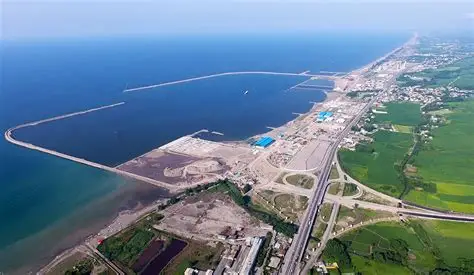
Caspian Port is one of Iran’s most strategic maritime projects on the southern coast of the Caspian Sea. It has been developed to enhance maritime trade, expand Iran’s share of international transit, and strengthen the economy of the country’s northern regions. Owing to its geographical position, location within the Anzali Free Trade Zone, and planned rail connectivity, the port is poised to become a major commercial hub in northern Iran.
Introduction
The expansion of port infrastructure in northern Iran is part of a national strategy to diversify trade routes and strengthen the country’s links with Eurasian markets. Caspian Port, as the most advanced seaport on the southern shore of the Caspian Sea, plays a pivotal role in the North–South Transport Corridor. Situated within the Anzali Free Zone, it connects maritime, rail, and road networks, allowing efficient movement of goods between Iran and neighboring countries.
Geographical Location and Features
Caspian Port is located in the Anzali Free Trade Zone in Gilan Province, on the southern coast of the Caspian Sea. Its strategic position places it at the heart of the regional trade network, linking Iran with Russia, Kazakhstan, Azerbaijan, and Turkmenistan.
The port has been designed as a multi-purpose terminal, capable of handling bulk, general, and containerized cargo. Through its connection to Iran’s national railway system, Caspian Port enables direct transfer of goods between northern and southern parts of the country, integrating maritime and land transport into a single logistics chain.
Infrastructure and Capacity
Caspian Port features modern quays, warehouses, cargo-handling equipment, and container terminals, providing high operational capacity. Key infrastructure components include:
-
Multipurpose berths designed for dry and bulk cargo.
-
Direct access to the Anzali Free Zone with special customs incentives.
-
Capability to accommodate medium-sized cargo and container vessels.
-
Planned full connection to Iran’s national railway network via the Qazvin–Rasht–Anzali line.
These characteristics make the port suitable for both domestic logistics and international transit operations.
Economic and Transit Importance
Caspian Port holds both economic and geopolitical significance as a core link in the International North–South Transport Corridor (INSTC). It facilitates cargo movement between Caspian littoral states, Central Asia, the Caucasus, and the Persian Gulf.
Its proximity to major markets such as Russia and Kazakhstan and its logistical connection to southern Iranian ports position it as a complementary node to the country’s southern maritime infrastructure.
The port’s location inside the Free Trade Zone provides investors with tax exemptions and customs advantages, attracting both domestic and foreign investment in shipping, warehousing, and logistics.
Challenges and Considerations
Despite rapid development, Caspian Port faces several challenges:
-
Limited water depth and draft restrictions inherent to Caspian Sea ports.
-
Need for continuous dredging and maritime infrastructure maintenance.
-
Competition with neighboring ports in Azerbaijan, Kazakhstan, and Russia.
-
Completion of rail and road infrastructure to ensure full connectivity.
-
Environmental concerns regarding the Anzali Lagoon and Caspian coastal ecosystems.
Addressing these issues will be essential for the port’s long-term efficiency and competitiveness.
Development Outlook
Future development plans for Caspian Port include expanding cargo-handling capacity, establishing new container terminals, building value-added logistics industries, and creating industrial zones adjacent to the port.
With the completion of the rail link and enhanced transit operations, Caspian Port could evolve into one of the key hubs of the International North–South Corridor, serving as Iran’s primary maritime gateway to Eurasia and beyond.
Conclusion
Caspian Port represents a new generation of Iranian ports — combining strategic geography, modern infrastructure, and economic incentives. Its development strengthens Iran’s position in regional and global trade routes, boosts economic activity in Gilan Province, and supports the country’s long-term goal of becoming a central player in Eurasian transit logistics.
No comments yet.